
Legislators are said to be miffed and have complained that they had not been able to get work done in their constituencies, and also transfers (of Government servants) as requested, and have expressed unhappiness regarding Ministers, alleging non-cooperation.

Amid imminent phasing out of the fiscal stimulus by US Federal Reserve, Prime Minister Manmohan Singh on Wednesday called for an "orderly exit" from unconventional monetary policies being pursued by the developed world for the last few years to avoid damaging growth prospects of the developing world.

Modi said it is an outcome of India's consistent reforms trajectory that the country's position is getting credence globally and is being recognised by international bodies like the IMF, World Economic Forum and UNCTAD.
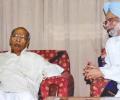
'Narasimha Rao asked me why China was doing so well in attracting foreign investments and I gave my frank opinion.' 'I told him that giving thrust to exports had to be a national effort.' 'But in India, the system was very centralised in the Government of India and the state governments had no role to play.'

Even a doomsayer like Nouriel Roubini says India is in a sweet spot. If only we'd live up to the promise, says Shekhar Gupta.

The attack by the Opposition party came a day after Prime Minister Narendra Modi unveiled the logo, theme and website for India's upcoming presidency of the grouping.

In a post on X, Modi said, "Happy to have welcomed @POTUS @JoeBiden to 7, Lok Kalyan Marg. Our meeting was very productive."
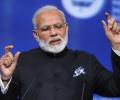
Modi is the first Indian prime minister to attend the Davos summit in 20 years.
It doesn't appear to be happening yet, even though India's stock market has been Asia's best performer this year.

The G20 foreign ministers' meeting on Thursday was unable to come out with a joint communique due to sharp differences over the Ukraine conflict despite persistent efforts by host India to build consensus.

Confidence in the state of the world economy has improved to some extent but majority of experts from business, government and civil society are still pessimistic, says a survey by World Economic Forum.

The full-court press on India over Ukraine, the BBC 'documentary', the Oxfam report, the Hindenburg attack on Adani and obliquely on the Indian economy, and any number of other acts are signs that India is a target, warns Rajeev Srinivasan.

The exhibition of artefacts -- in physical and digital formats -- will be done on the same floor level where the leaders' meetings will take place, and they will walk through this 'cultural corridor' while moving into and out of the summit room, official sources said.

In a statement ahead of his visit to the Indonesian city for the G20 leaders' summit, Modi said he will also highlight India's achievements and its 'unwavering commitment' to collectively address key global issues.
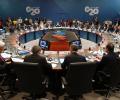
For India, the talks will work as another opportunity to sharpen its positions ahead of the formal UN negotiations.
The number of Indians over 15 either working or looking for work is lower as a percentage than in the United States, China, Bangladesh or Pakistan, points out Aakar Patel.

The target is called Intended Nationally Determined Contributions.

The Modi government finds itself in a contradiction of its own making. It has encouraged pro-Russian, Westophobic public sentiment while setting strategic policy that's exactly the opposite, points out Shekhar Gupta.

The government believes that WTO's push for initiating negotiations on substantive obligations related to e-commerce will oblige India to permanently accept the current moratorium on imposing customs duties on products traded electronically.

Foreign Secretary Vinay Kwatra on Wednesday refused to speculate on whether the G20 foreign ministers' meeting would be able to come out with a joint communique against the backdrop of widening differences between the West and Russia on the Ukraine conflict.

Municipal authorities have envisioned a comprehensive and pro-active plan to combat dengue this year with focussed fumigation at monument sites and markets in Delhi, which will host the G20 summit in September.
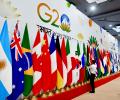
The silver lining for India's presidency is likely to be the support by almost all G20 countries to its proposal to include the African Union as a permanent member of the bloc that has emerged as perhaps the most influential multilateral forum after the United Nations.

"I have made a mistake; I accept responsibility; I resign," the 42-year-old barrister said.

Al Thawadi said he had been consulting with industry experts and also planned to engage with other major sports events, such as the Tokyo Olympics, which has been postponed to 2021 from this year, as Qatar looks to respond to the crisis.
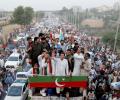
'Nobody wants him to gain power.' 'But saying that all these players together conspired against Imran Khan and had him arrested would be in the realm of conjecture but possibilities cannot be ruled out.'

The so-called 'fourth industrial revolution' will bring ever faster cycles of innovation, posing huge challenges to companies, workers, governments and societies alike
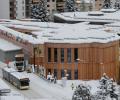
The WEF meeting is crucial because of its theme encompassing globalisation at the time of rising nationalism and trade war, and the fourth industrial revolution due to rapid strides being made in robotics and artificial intelligence.
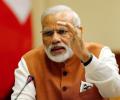
India is investing in developing indigenous capabilities in 5G and 6G telecom technologies besides focusing on manufacturing semi-conductors, Prime Minister Narendra Modi said on Thursday. In a virtual address at the Sydney Dialogue, the prime minister said the "greatest product" of technology today is data and that India has created a robust framework of data protection, privacy and security. "And, at the same time, we use data as a source of empowerment of people. India has unmatched experience in doing this in a democratic framework with strong guarantees of individual rights," he said.
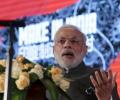
The industrial partnership of China and India can bring about greater investment and employment.

Geithner said during their discussions this week, in Singapore and China, US President Barack Obama emphasised that the US and China must be at the centre of efforts to put the global economy on a more sustainable and balanced growth path.

More than 70 per cent of Indian youth aged between 15 and 29 can't!

The 'Missing link in India's Act East Policy', as India's former foreign secretary Shyam Saran calls it, needs to be filled sooner rather than later, says Dr Rahul Mishra.
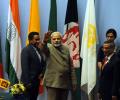
'If his three priorities are the economy, the economy, the economy, then there is need for a stable region, a stable neighbourhood.'
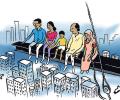
India's residential market is expected to sustain demand momentum despite rise in mortgage and property rates as sales this year across the top 7 cities are likely to breach pre-pandemic level of 2.62 lakh units, industry players said. After braving four back-to-back disruptions in form of demonetisation, RERA, GST and COVID-19 in the last 6 years, industry experts feel the housing market is going through a lot of structural changes and is now at the start of a long-term upcycle. Homebuyers body FPCE gives credit to the Real Estate Regulatory Authority (RERA) under the Real Estate (Regulation & Development) Act, 2016 for this improved buying sentiment.

The findings, released at the World Economic Forum meeting in Davos on Friday, come at a time when the global economy is going through stressful times.

Opposition leaders urged Modi to use the opportunity for the country's benefit.

During the meeting on the sidelines of the 11th BRICS Summit on Wednesday, prime minister Modi said there was a "new direction and new energy" in bilateral ties after the two leaders' second informal summit in Chennai.

Underlining that years of economic stagnation have given way to a "roaring geyser of opportunity", Trump said, "I knew that if we unleashed the potential of our people, cut taxes, slashed regulation, fixed broken trade deals and fully tapped American energy that prosperity would come thundering back ... and that is exactly what happened."

'Higher than expected inflation in the US or the European Union, faster than expected tightening by the major central banks, break out of a war in Europe, and withdrawal of portfolio equities from the emerging markets are factors which can result in equity market corrections.'

Russia has been grappling with sanctions slapped by the US and its allies over Moscow's invasion of Crimea.
